
Developing a toothbrush head means matching its shape, filaments and tuft layout to the user, handle and production requirements.
International design examples
What can established brush heads teach an OEM team?
Three established products illustrate distinct choices in tuft direction, filament height and head flexibility.
Oral-B CrossAction: tuft orientation
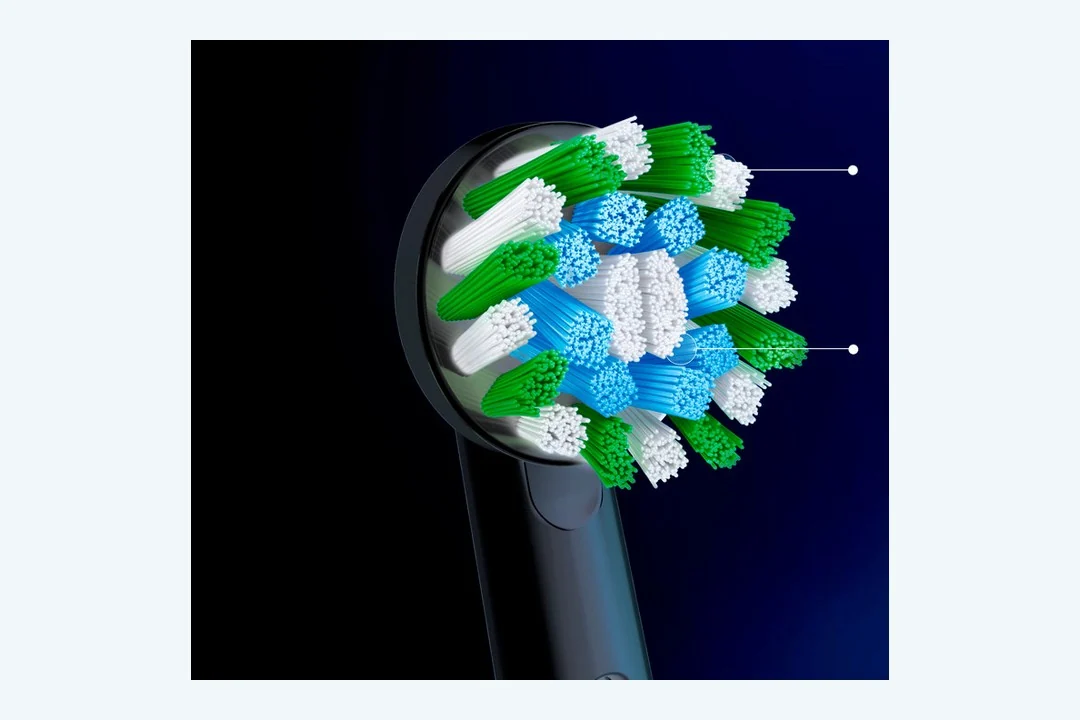
Oral-B specifies 16° bristles for CrossAction. The useful lesson is to develop tuft orientation together with the intended brush motion.
TePe Supreme: two filament levels
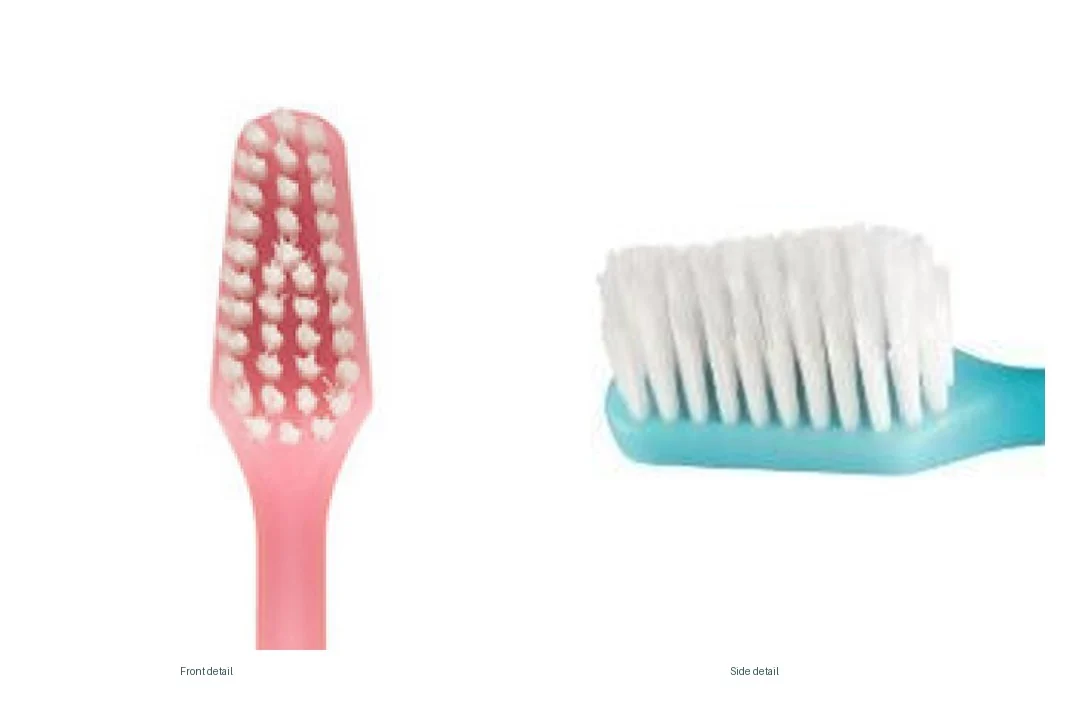
TePe Supreme uses two filament levels in a manual brush. It illustrates how height can define a contact profile; a sonic version would need its own evaluation.
Philips Sonicare C3: flexible head sides
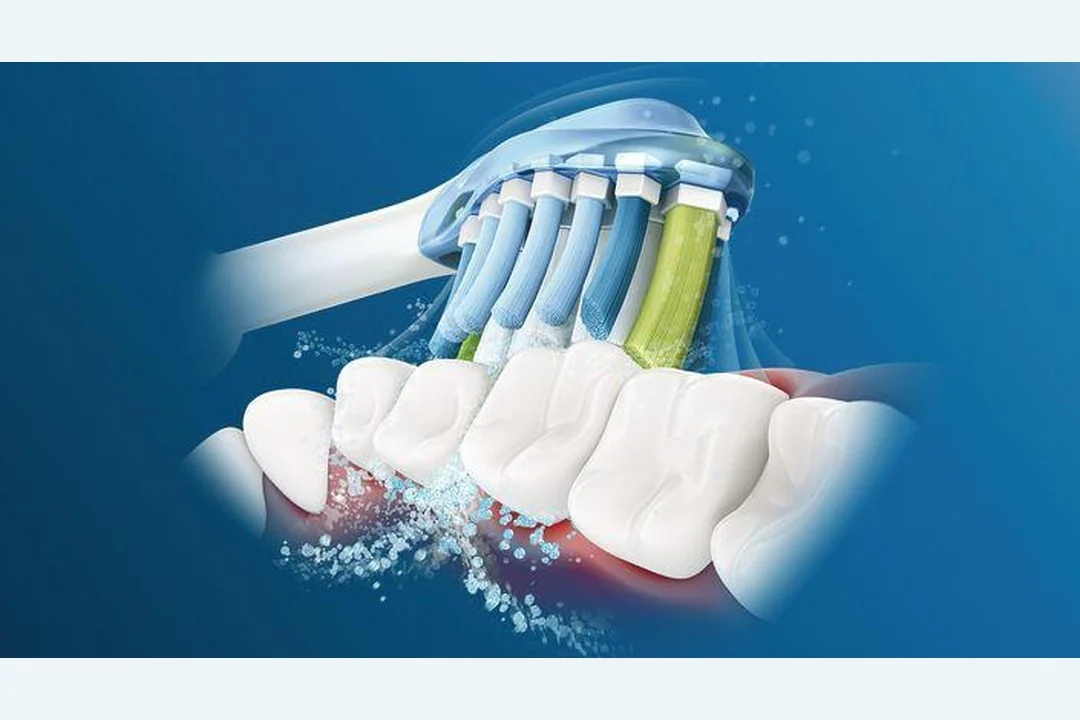
Philips C3 Premium Plaque Defence has soft, flexing sides. It shows that the head structure, as well as the filaments, can be a design variable.
Brand examples are independent references. No affiliation or compatibility with BESTCLEAN is implied.
01 / Start with the user
Write the brief before drawing the tuft pattern.
Define the user, desired feel, handle platform and target cost. Then identify the required changes to an existing head—or the reason to develop a new one.
Target user, intended brushing routine and desired feel.
Handle platform, connector and replacement-head requirements.
Head silhouette, colors and product-family identity.
Target cost, order quantity, tooling scope and validation plan.
02 / Shape & access
Design for access, not just surface coverage.
Length, width, thickness and neck shape determine how easily a head can be positioned. A compact design offers maneuvering space; a broader head provides more room for tufts.
Check clearance around the back teeth, including the back of the head and neck. The ADA recommends a size and shape that allows access to all areas.1
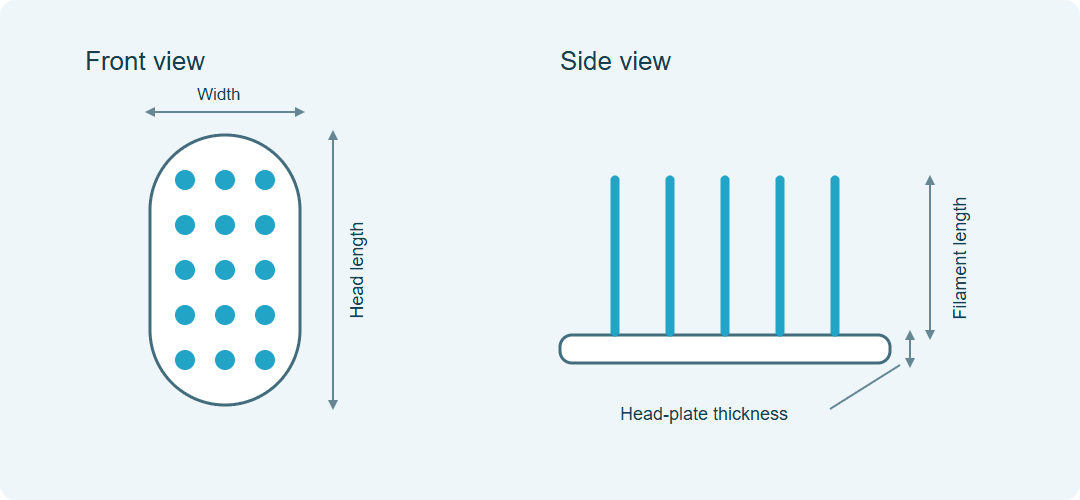
Can the intended user position and turn the head comfortably around the back teeth, without the head body or neck getting in the way?
03 / Filaments & feel
Specify what “soft” should mean in the finished head.
Material, diameter and exposed length affect filament bending. Tuft size, spacing and packing influence the assembled head.2
With other conditions unchanged, finer or longer filaments generally bend more easily. Compare wet samples to assess the combined effect of these variables.
| Decision | What to explore | What to verify |
|---|---|---|
| Material & diameter | Flexibility and support | Actual grade, dimensions and wet-use behavior |
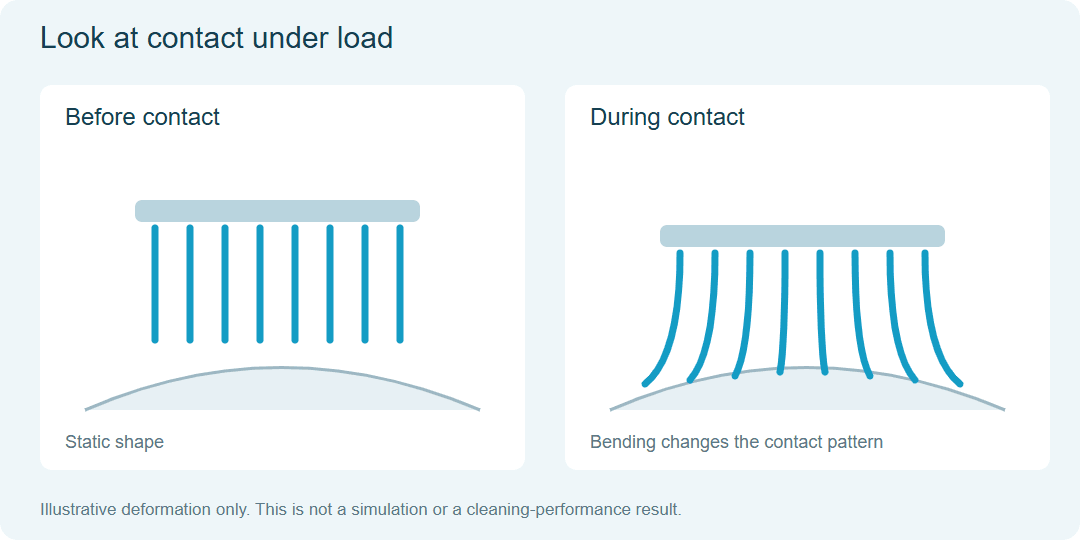
| Exposed length | Reach and bending space | Contact under load and shape recovery |
| Tuft size & spacing | Distribution of contact | Local feel, movement and manufacturability |
| Tip treatment | End-rounded or tapered filament options | Appropriate finishing quality and evaluation method |
A systematic review found insufficient evidence for an overall plaque-removal advantage of tapered over end-rounded filaments. Select the tip form and finishing method for the complete design.3
For a comfort-led design, assess wet-use feel and shape recovery. Soft bristles are the ADA’s general recommendation.1
04 / Layout, profile & identity
Give each design change a purpose.
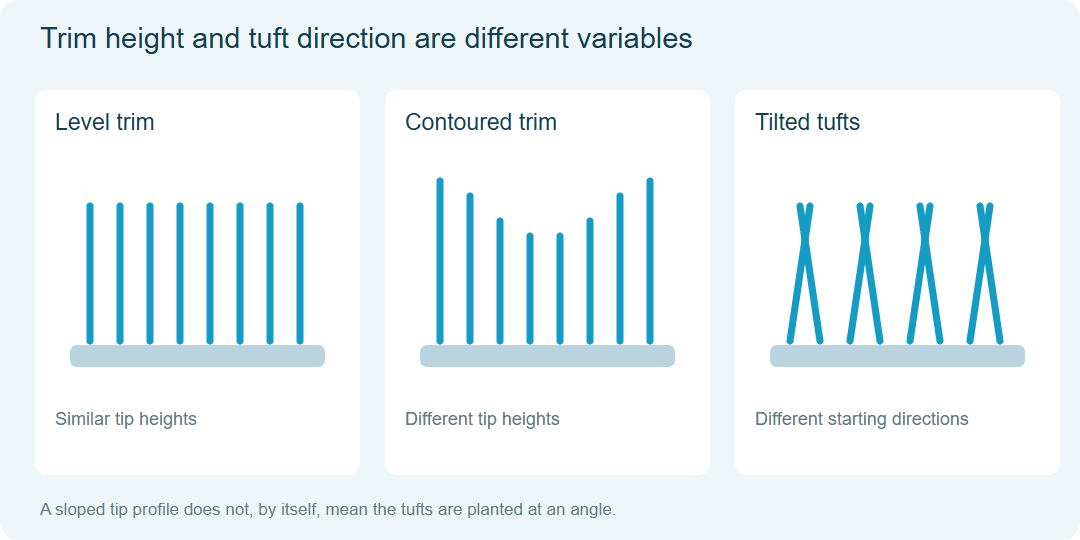
Specify three separate features: the front-view tuft map, the side-view trim profile and the planting angle of each tuft.
| Design approach | Intended purpose | Development question |
|---|---|---|
| Relatively level trim | Establish a straightforward contact baseline | How does it contact curved tooth surfaces? |
| Contoured / multilevel trim | Vary where and when different tufts engage | Do longer tufts keep useful contact when they bend? |
| Angled / cross-angled tufts | Explore contact from different directions | Does the orientation suit the actual brushing motion? |
| Ring, island or elongated tuft groups | Organize the contact field and visual pattern | Does each zone have a defined role in the specification? |
A 2024 manual-brush review found weak-certainty short-term evidence favoring cross-angled tufts, without the same advantage in longer-term plaque results. Treat this as a design option, not proof for a new powered head.4
Use color to explain the product family.
Coordinate head and tuft colors with the handle and packaging. If colors indicate different filament specifications, document those differences.
BESTCLEAN brush head references
Compare common brush head options.
Use these front and side views to select a starting point for sample discussions.
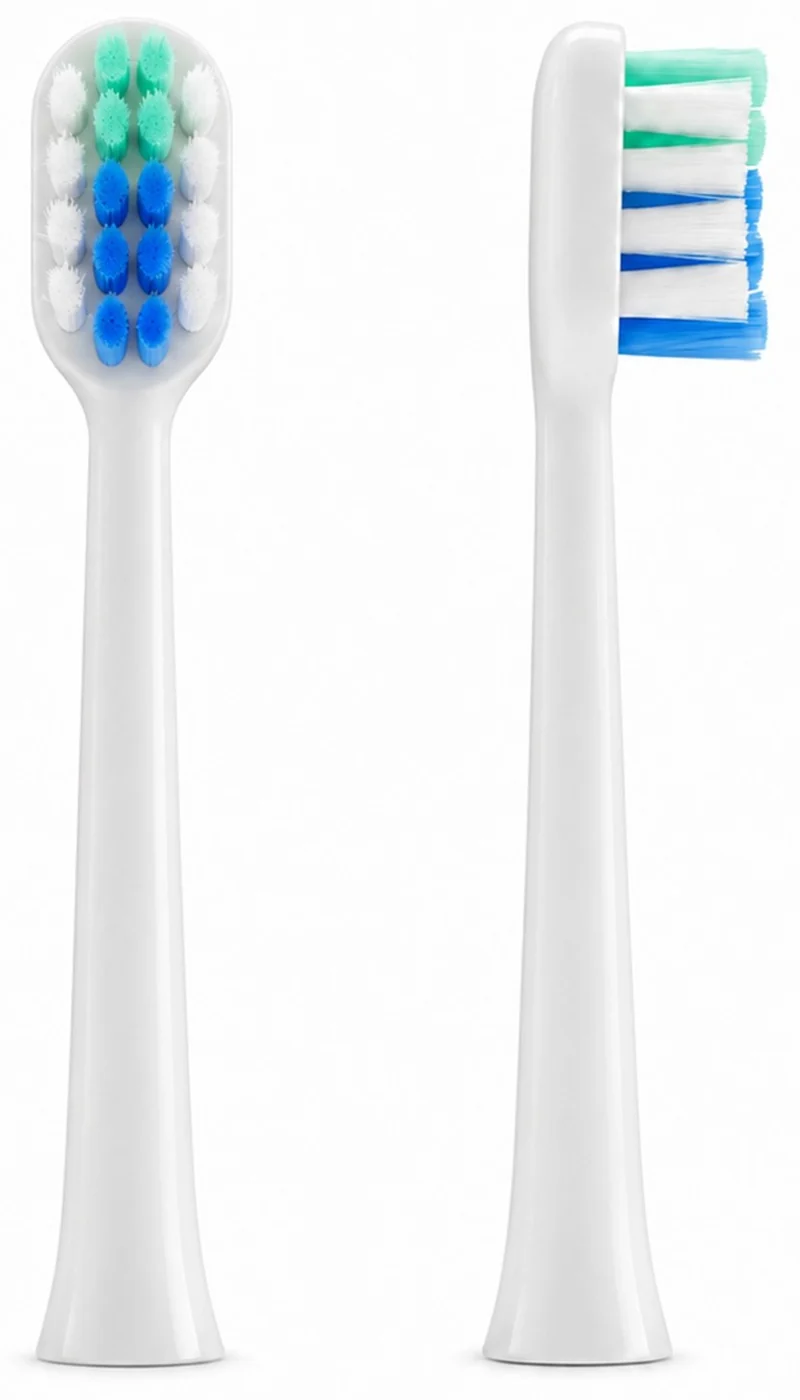
Mint and blue tufts in a rounded rectangular head.
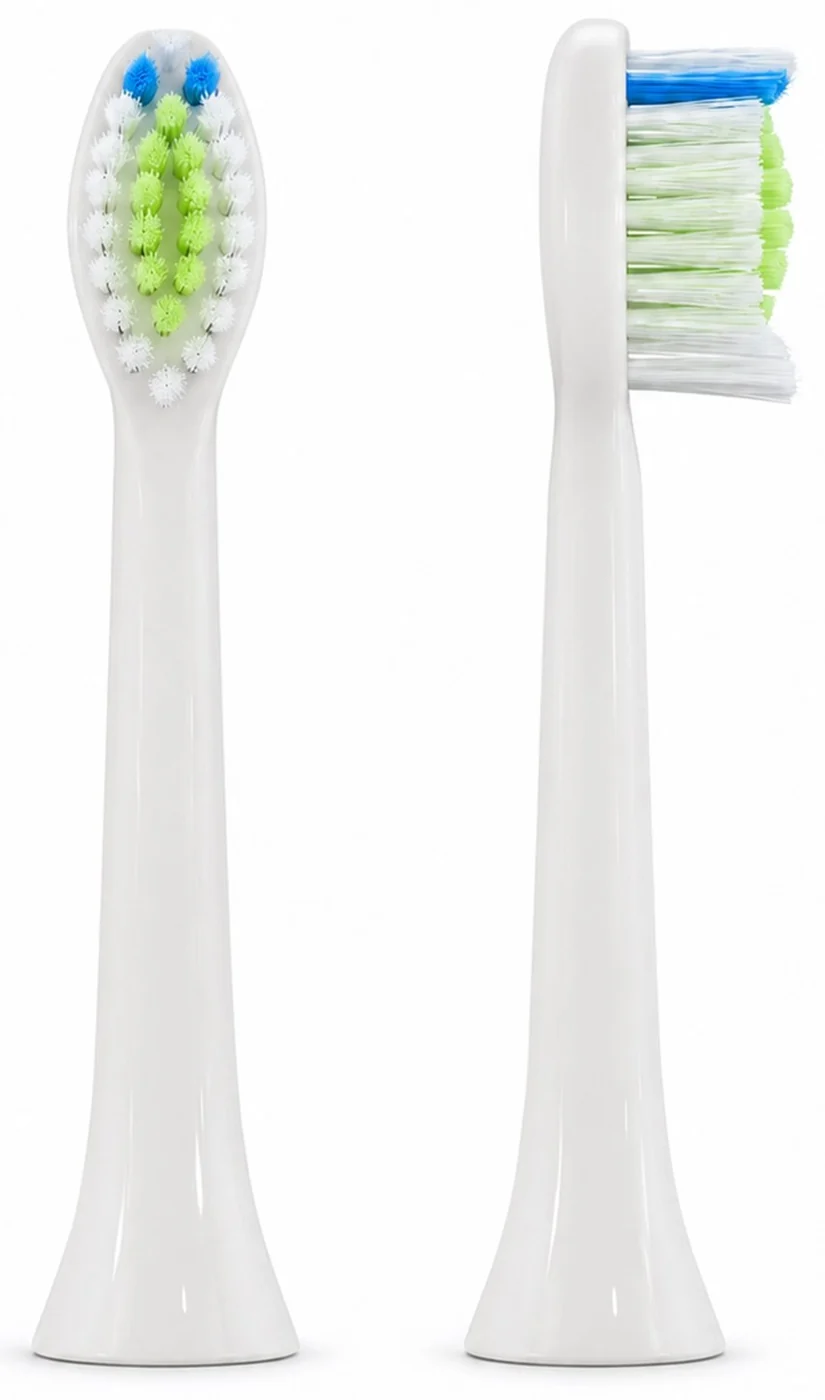
Green center tufts, white outer tufts and a blue tip area.
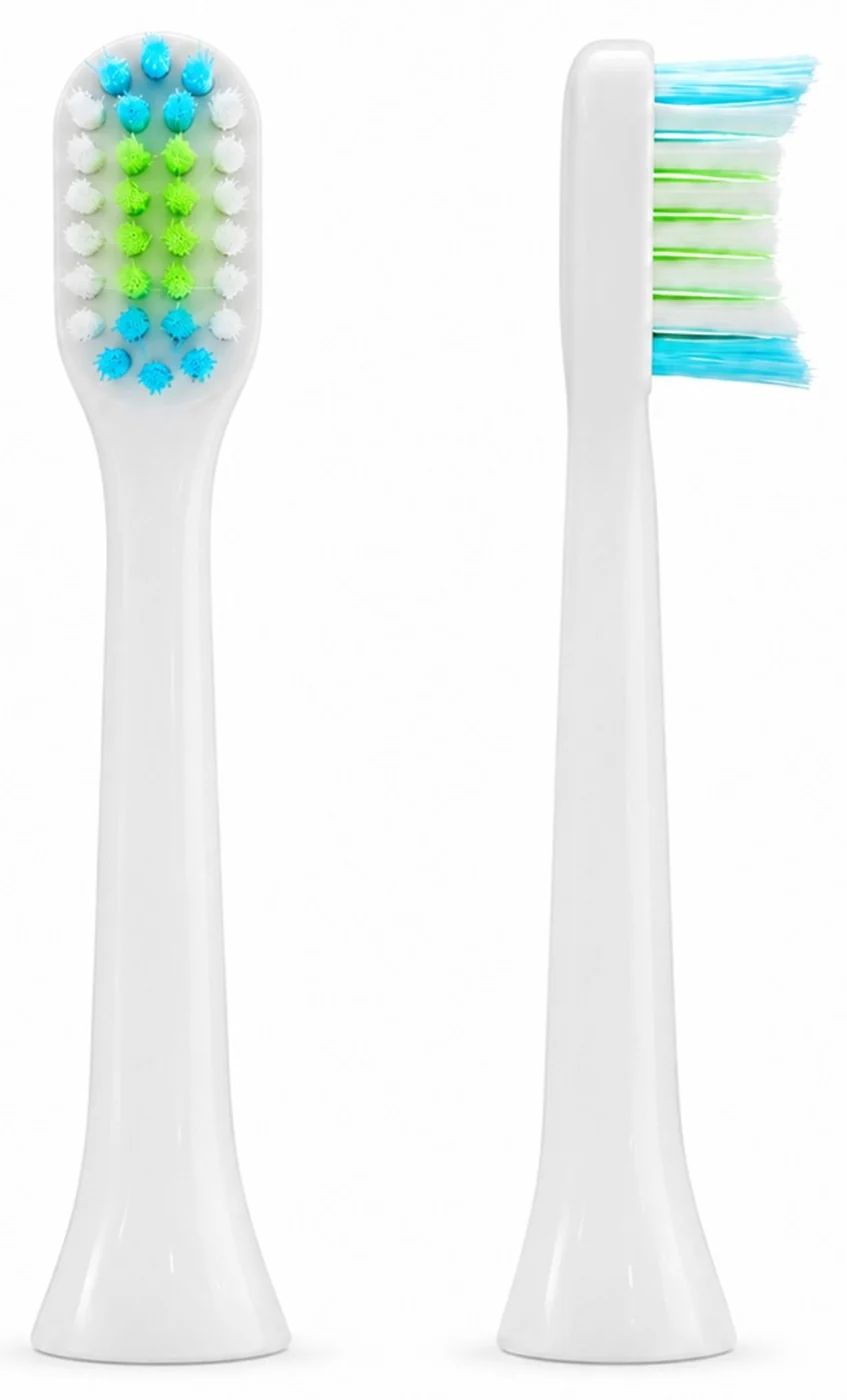
Cyan end areas and green center tufts; the side view shows a contoured profile.
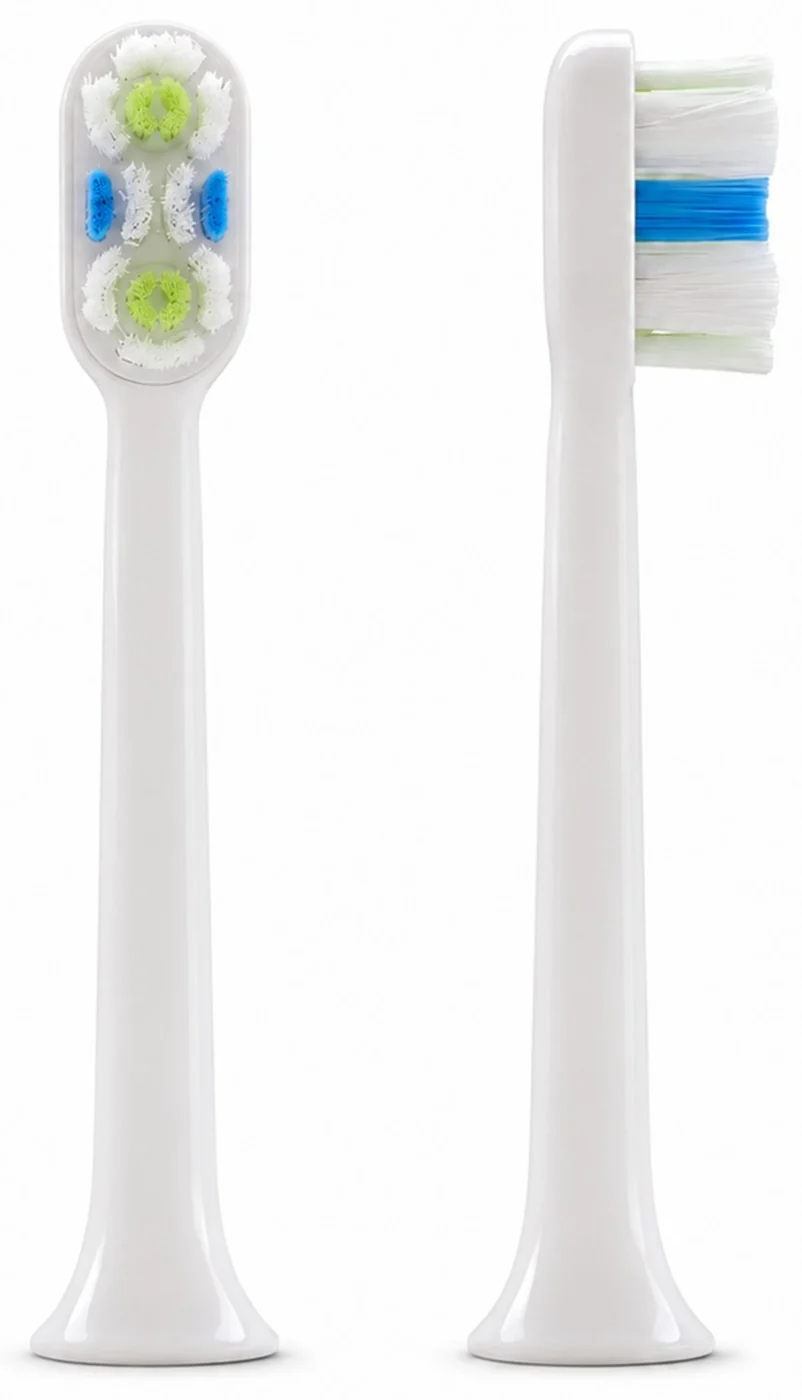
Ring-shaped groups at both ends, with elongated blue groups at the sides.
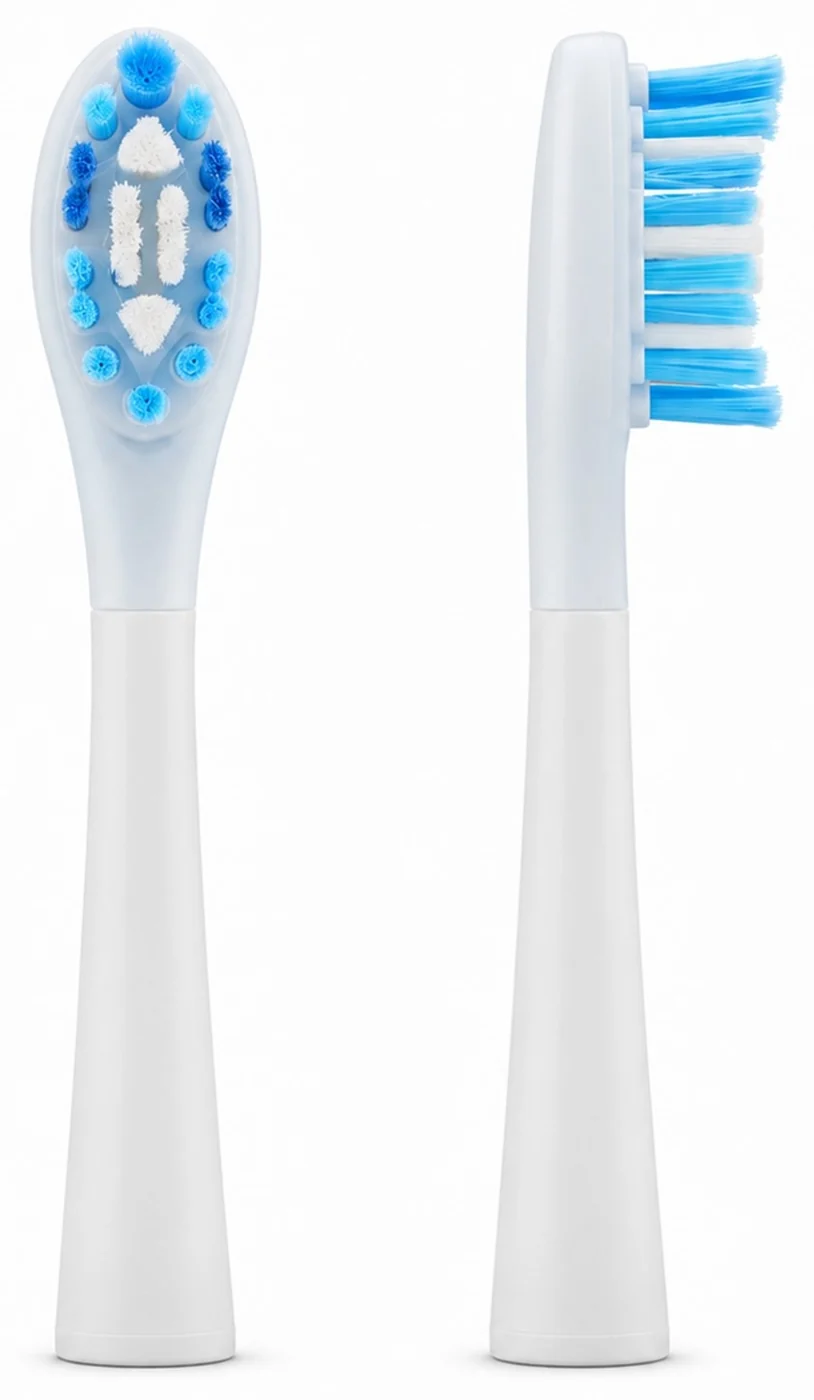
Blue perimeter tufts surrounding white center groups.
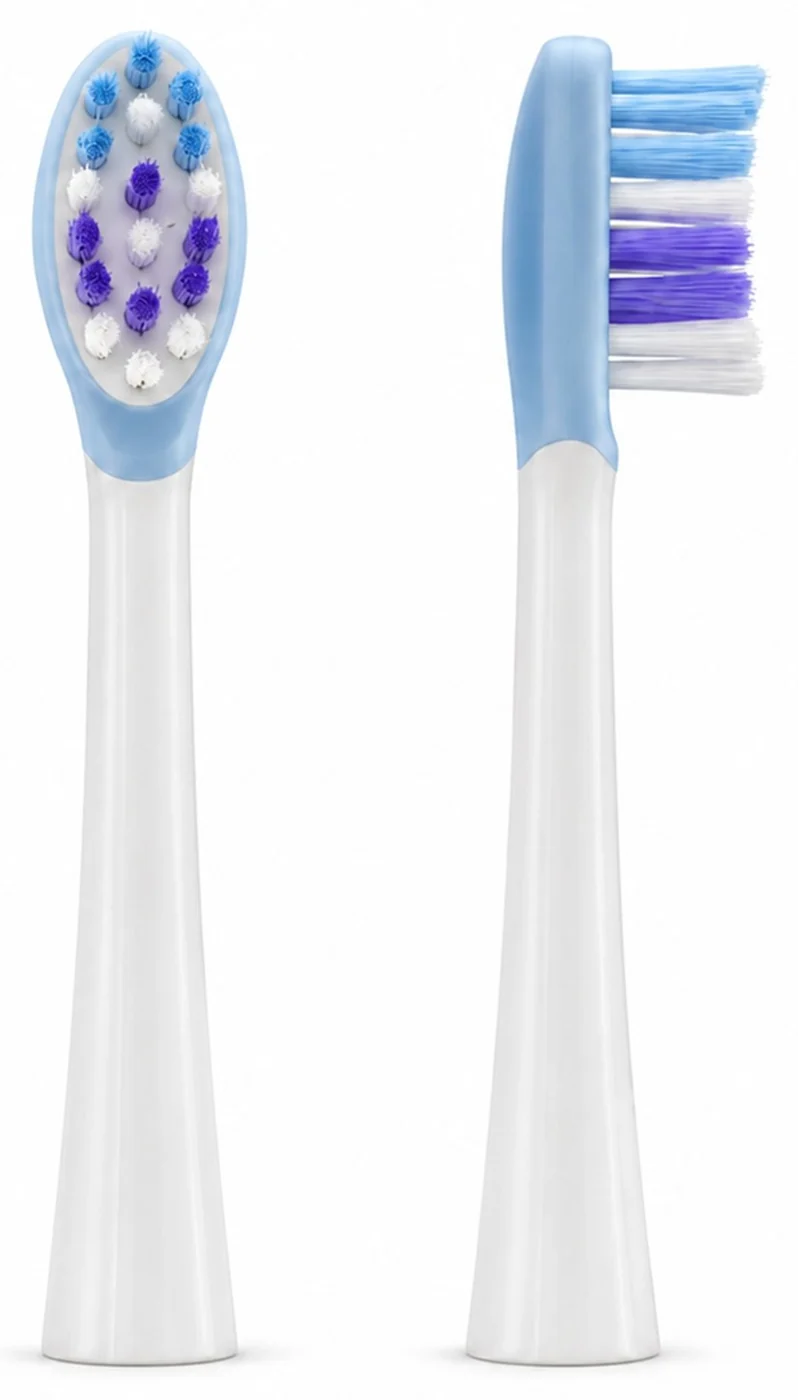
A pale blue neck with white, blue and purple tuft groups.
05 / The powered system
Test the head on the handle that will drive it.
Test the head on its intended handle. A vibration study found that contact load affected filament movement differently across powered brushes.5
Compare fit, movement under load, noise and feel using the same handle and operating mode.
06 / From concept to a controlled sample
Resolve production details before approving the head.
Confirm that the tuft shapes, hole spacing, plate and finishing suit the manufacturing route. Both anchored and anchor-free equipment offer design options.6
Change one main variable at a time. Compare trim profiles with the same filaments and handle, then compare filament options using the selected profile.
Build an approval checklist around separate questions.
- Geometry and fit: dimensions, connector match and assembly consistency.
- Finishing and retention: appropriate filament-tip assessment, tuft security and structural checks.
- Use and durability: wet-use feel, wear, splaying and shape recovery.
- Cleaning claims: an appropriate test design and comparator for the proposed claim.
- Production reference: approved drawings, material specifications and a controlled sample.
Use ISO 20127:2025 to guide applicable physical-property checks. End-rounding requirements vary by filament type; cleaning claims require separate evidence.7
07 / Start your concept
Explore a brush head in 3D.
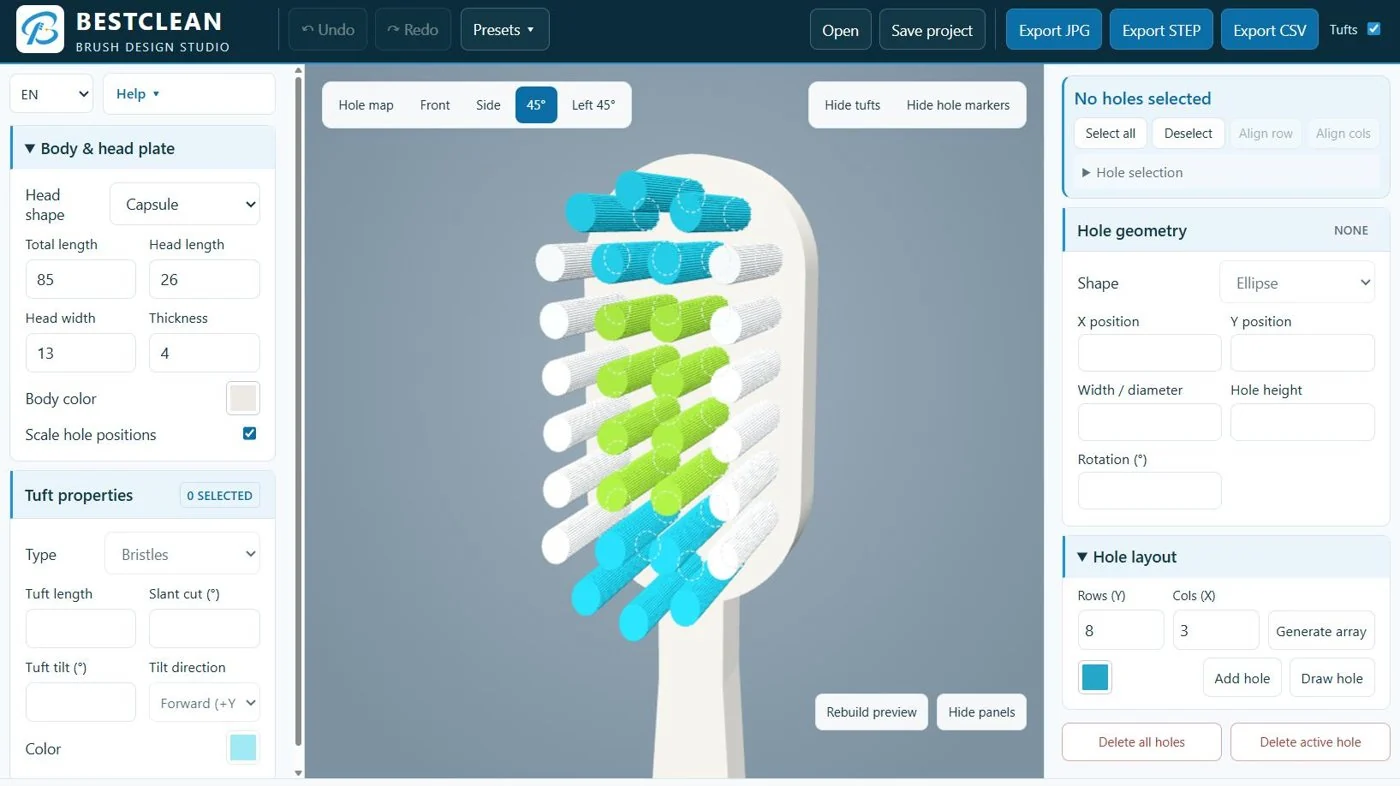
Explore head geometry, tuft positions, heights, directions and colors in BESTCLEAN Brush Design Studio. Save the project and export a STEP file for engineering discussion.
Questions before starting an OEM brush head project
Should we start with an existing head or a new design?
Start with an existing head if it suits the handle and brief. Develop a new design when the required geometry or fit calls for different tooling.
Can photographs tell us which head is softer?
Photos show shape, color and layout. Confirm filament specifications and assess softness with samples.
Does a 3D model prove that a design can be manufactured?
A model communicates geometry. Engineering review must still confirm fit, tolerances, tufting and production feasibility.
Develop a brush head around your product brief.
Send your target handle, reference head, proposed changes and estimated quantity to discuss an OEM/ODM project.
References
- American Dental Association — Toothbrushes
- A mathematical model for predicting toothbrush stiffness
- Tapered versus end-rounded filaments: systematic review and meta-analysis
- Cross-angled versus flat-trim tuft configurations: systematic review (2024)
- The effects of load and toothpaste on powered toothbrush vibrations
- ZAHORANSKY — CUBE; Boucherie — AFT technology
- ISO 20127:2025 — Physical properties of powered toothbrushes